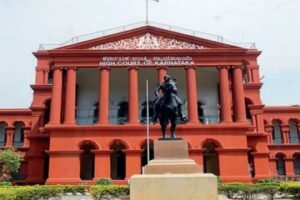
ED Is Not a ‘Super Cop’ and Cannot File Private Complaints, Rules Karnataka High Court in YB Ashwathanarayan v. Union of India
Case: YB Ashwathanarayan v. Union of India
Date of Judgment: 06 November 2026
Court: High Court of Karnataka
Coram: Justice M.I. Arun
Court Observation
“The power of the ED is derivative and not original. It cannot initiate an investigation suo motu based on a standalone suspicion of money laundering. If there is no existence of the predicate offence, then in that event, proceedings under PMLA cannot exist; meaning even when the predicate offence is terminated in favour of the accused therein, the proceedings under PMLA cannot continue.”
Summary
The Karnataka High Court has held that the Enforcement Directorate is not a “super cop” empowered to investigate anything and everything that comes to its notice, quashing a money-laundering probe against Congress MLA K.Y. Nanjegowda and others. The Court held that the ED’s power under the Prevention of Money Laundering Act, 2002, is derivative and not original: it can act only where a predicate (scheduled) offence exists, and if the predicate offence ends in the accused’s favour, the proceedings under the Act cannot continue.
The Court further held that the Act does not expressly empower the ED to file a private complaint in respect of a scheduled offence and then use that complaint as the foundation for money-laundering proceedings. Under Section 66(2) of the Act, if the ED comes across material suggesting other offences, it must forward it to the competent agency rather than take up those offences itself merely because that agency does not act. Allowing the ED to file private complaints would let it investigate anyone on its own, contrary to the scheme of the Act and to the separation of powers, since maintaining law and order is the State’s responsibility, not the Centre’s.
Key Holdings
- The Enforcement Directorate’s power under the Prevention of Money Laundering Act, 2002, is derivative and not original — it can act only where a predicate (scheduled) offence exists; if the predicate offence is terminated in favour of the accused, proceedings under the Act cannot continue.
- The Act does not expressly empower the Enforcement Directorate to file a private complaint under Section 200 of the Code of Criminal Procedure (now Section 223 of the Bharatiya Nagarik Suraksha Sanhita, 2023) in respect of a scheduled offence and thereafter investigate on its own strength.
- Under Section 66(2) of the Act, if the Enforcement Directorate comes across material suggesting violations of other laws during an investigation, it must inform the concerned agency rather than investigate those offences on its own.
- Allowing the Enforcement Directorate to prefer a private complaint when other government authorities deem it inappropriate to initiate proceedings would amount to permitting it to act as a “super cop”, which goes against the philosophy of the Act requiring a predicate offence to be in existence.
Directions Issued
- The Enforcement Case Information Report dated 30 November 2023, the summons issued under it, the private complaint filed before the special court, and all proceedings against the petitioners stand quashed.
- The Adjudicating Authority’s order dated 6 June 2024 confirming the seizure of articles stands set aside insofar as it concerned one petitioner, and the Enforcement Directorate shall return the articles seized from Y.B. Ashwathanarayan.
Background
The Enforcement Directorate took cognizance of a land-scam case in which Malur Land Grant Committee chairman and Malur Congress MLA K.Y. Nanjegowda and others were accused of illegally allotting about 80 acres of government land to 38 persons. Nanjegowda later became chairman of the Kolar and Chikkaballapur Milk Union Ltd. (KOMUL); the Directorate said it found material about a recruitment scam in the milk union and summoned its then director, Y.B. Ashwathanarayan. Meanwhile the land-scam case was dismissed by the trial court for want of government sanction to prosecute a public servant, and the jurisdictional police filed a closure report — yet the Directorate pressed on, filing a private complaint before the special court for MPs and MLAs to force a Lokayukta probe into the recruitment allegations. The petitioners — Nanjegowda, Ashwathanarayan, K.N. Gopala Murthy, Nagesh N. and C. Raju Krishna — challenged the information report, the summons, the seizure confirmation and the private complaint. The Court has now allowed their petitions.
Related Articles
- Bombay High Court Sets Aside ₹100 Crore PMLA Freeze on Coda Payments, Cites Lack of Reasoned Order
- Enforcement Directorate Exempted From RTI Act except When Information Relates to Allegations of Corruption or Human Rights Violation: Delhi HC
Disclaimer: This is a summary prepared for informational purposes only and does not constitute legal advice. Readers should refer to the official judgment for the authoritative text.