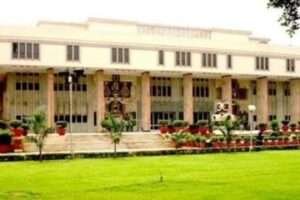
Private Insurers Are Amenable to Writ Jurisdiction, Rules Delhi High Court in Sushma Tyagi v. HDFC Ergo General Insurance Company
Case: Smt. Sushma Tyagi v. M/s HDFC Ergo General Insurance Company Limited, through its Director & Ors.
Citation: 2026:DHC:10223
Date of Judgment: 18 November 2026
Court: High Court of Delhi
Coram: Justice Jasmeet Singh
Proceedings: W.P.(C) 168/2024 & CM APPL. 37041/2026
Court Observation
“I am of the view that even though the respondent No. 1 is a private entity and is not financially, functionally and administratively dominated by or under the control of the Government, the respondent No. 1 is still amenable to this Court’s jurisdiction under Article 226.”
Summary
The Delhi High Court has held that private insurance companies like HDFC Ergo perform functions of a public character and are amenable to writ jurisdiction under Article 226 of the Constitution, despite not being instrumentalities of the State. Justice Jasmeet Singh allowed a widow’s petition, set aside the insurer’s repudiation of her claim and the Insurance Ombudsman’s award, and directed payment of her late husband’s insured interest.
The petitioner’s husband, Anand Kumar Tyagi, and his brother Naresh Kumar Tyagi had jointly purchased a residential property (B-803, Casa Woodstock, Sector 16-C, Greater Noida) after availing a home loan of Rs 50 lakh in July 2018, and had taken a five-year “Home Credit Assure” policy covering nine major medical illnesses including “Myocardial Infarction”. Anand Kumar Tyagi died of cardiac arrest on 20 April 2021. HDFC Ergo repudiated the claim on 3 July 2021, saying death due to cardiac arrest, respiratory failure and bilateral pneumonitis was not covered. An earlier writ petition (W.P.(C) 8320/2023) was disposed of on 14 July 2023 directing her to approach the Insurance Ombudsman. She complained on 26 July 2023; at the hearing on 25 September 2023 she was given a blank mediation/settlement form and pressed to sign it, and on 26 September 2023 the Ombudsman dismissed her complaint, recording that she had refused to sign a mediation form.
Key Holdings
- Even though a private insurer is not financially, functionally or administratively dominated by or under the control of the Government, it is amenable to Article 226 jurisdiction: insurance companies act as a social safety net for the general public and perform functions akin to those of the State; the nature of the functions performed, rather than merely the legal status of the entity, is relevant.
- Cardiac arrest falls within “Myocardial Infarction” under the policy: the insurer’s own case was that both conditions arise from disrupted blood supply and are described in general parlance as a “heart attack”; a narrow reading would substantially defeat the purpose of the cover; the burden of proving an exclusion lies on the insurer.
- Where a complainant does not sign the mediation form, the Insurance Ombudsman is required to adjudicate the complaint and take it to its logical conclusion; under Rule 17(1) of the Insurance Ombudsman Rules, 2017, an Ombudsman “shall pass an award” where mediation does not settle the complaint. An Ombudsman’s orders involve civil consequences and must observe the principles of natural justice.
- The court declined to require expert medical opinion and followed the Madras High Court’s decision in Jasmine Ebenezer Arthur v. HDFC Ergo (2019) on the same point.
Directions Issued
- The writ petition is allowed; the repudiation letter dated 3 July 2021 and the Ombudsman’s Award dated 26 September 2023 are quashed and set aside.
- HDFC Ergo is directed to pay the petitioner Rs 27,97,445 (50 per cent of the insured sum of Rs 55,94,890, being her late husband’s share as one of two insured persons), with interest at 9 per cent per annum from 3 July 2021 until actual payment.
- HDFC Ergo is further directed to pay Rs 5,08,176 towards the loan-interest component (out of Rs 10,16,352 paid by her on the home loan from April 2021), together with the interest component paid on that portion thereafter until actual payment.
Background
The petitioner is the widow of Anand Kumar Tyagi. She and her husband’s brother bought the Greater Noida property jointly; only her husband paid the EMIs (Rs 45,309 per month) from his proprietorship concern, M/s Deep Glass Emporium, and paid a premium of Rs 5,94,890 for the policy (No. 2999202171789000000, term 18 July 2018 to 18 July 2023). After her husband’s death on 20 April 2021 she continued paying the EMIs to retain the home. The claim was filed on 29 June 2021 and repudiated on 3 July 2021. She first approached the High Court in 2023 and was directed to the Ombudsman; the Ombudsman’s award of 26 September 2023 dismissed her complaint on the ground that she had refused to sign a mediation form — she says she was given only a blank settlement form and pressed to sign it, including by an official, Mr R.K. Sirova.
Related Articles
- Insurance Company Cannot Take A Defense Which Did Not Form The Basis Of Repudiation Of The Claim: Supreme Court
- Insurance Ombudsman Performs Quasi-Judicial Functions While Deciding Complaints; Award Can Be Challenged Under Article 227: Bombay High Court
Judgment Link: https://delhihighcourt.nic.in/app/showFileJudgment/JSM18112026CW1682024_191155.pdf
Disclaimer: This is a summary prepared for informational purposes only and does not constitute legal advice. Readers should refer to the official judgment for the authoritative text.