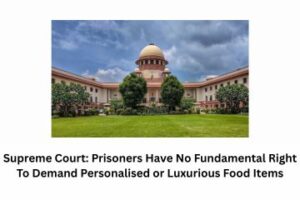
Voters Can File Private Complaints Over False Election Affidavits, Rules Supreme Court in Rajkumar Madki v. Dr. Shailendra Beldale
Case: Sri Rajkumar Madki v. Dr. Shailendra Beldale
Citation: 2026 INSC 1138
Date of Judgment: 16 October 2026
Court: Supreme Court of India
Coram: Justice Dipankar Datta and Justice Sheel Nagu
Proceedings: Criminal Appeal No. 3387 of 2026
Court Observation
“If indeed it were the intention of the legislature that cognisance of any offence relating to the furnishing of false information by a candidate in an affidavit with intent of being elected in an election could only be taken if the complainant were a public servant, the same could have been provided by an amendment of Section 195 CrPC.”
Summary
The Supreme Court has held that a private individual, including a voter, can file a criminal complaint against a candidate for allegedly furnishing false information or concealing information in an election affidavit. Such a complaint under Section 125A of the Representation of the People Act, 1951, need not satisfy the restrictions in Section 195 of the Code of Criminal Procedure, 1973, which require a complaint by a public servant for certain specified offences.
The Court held that Section 125A does not appear in the list of offences in Section 195(1)(a) of the Code of Criminal Procedure. Section 125A was inserted in 2002, and Section 195 was amended in 2006 without adding Section 125A to that list, which the Court treated as a deliberate omission. The Court also noted that Section 125A applies notwithstanding anything contained in any other law for the time being in force.
Importantly, the ruling on the legal question did not revive the complaint in this particular case. The Court set aside the Karnataka High Court’s reasoning that only the Election Commission or a public servant could complain, but left the quashing of the complaint against the respondent in place on grounds other than the Section 195 bar. The Court also observed that magistrates remain equipped to deal with complaints filed to harass a candidate or containing frivolous allegations.
Key Holdings
- A private complaint alleging an offence under Section 125A of the Representation of the People Act, 1951, need not pass muster under Section 195 of the Code of Criminal Procedure, 1973.
- Section 195(1)(a) of the Code of Criminal Procedure lists specific offences for which cognisance requires a complaint by a public servant, and Section 125A is not among them.
- The omission of Section 125A from that list when Section 195 was amended in 2006, four years after Section 125A was introduced, must be treated as deliberate, and courts cannot expand the list by implication.
- No provision restricts complaints under Section 125A exclusively to a public servant or to the Election Commission.
- The non-obstante clause in Section 125A reinforces that its penalty for falsehood applies notwithstanding anything contained in any other law for the time being in force.
Directions Issued
- The Karnataka High Court’s reasoning that a Section 125A complaint could be made only by the Election Commission is set aside, while the quashing of the complaint in this case is left in place on other grounds.
Background
The appellant lodged a private complaint on 21 August 2023 before the 42nd Additional Chief Metropolitan Magistrate at Bengaluru, alleging that the respondent, who was elected to the Karnataka Legislative Assembly from the Bidar constituency in 2023, had made a false disclosure about his residential address in the affidavit accompanying his nomination paper. The Karnataka High Court, by a judgment dated 7 March 2025 in Writ Petition No. 7458 of 2024, quashed the complaint, holding that Section 125A had to satisfy Section 195(1) of the Code of Criminal Procedure and that only the Election Commission could complain. The Supreme Court disagreed with that reasoning, while leaving the quashing in place on other grounds.
Related Articles
- Courts Can Step In to Protect Free and Fair Elections, Rules Supreme Court
- Electoral bonds aftermath: Voter rights to candidate info under RPA 1951, post-2023 SC strike-down effects on political funding transparency
- Prosecution Is Not Bar By Investigating Agency Under Section 195(1)(b)(i) CrPC For Offence Under Section193 IPC Committed During Investigation Stage
Disclaimer: This is a summary prepared for informational purposes only and does not constitute legal advice. Readers should refer to the official judgment for the authoritative text.